Showing posts with label Sam. Show all posts

Saturday, August 29, 2009

Big Welcome Home

Well, we got back at the end of July. I didn’t really finish my Japan blog posts, and will soon post a bunch that are already drafted. Including my other superhero entry and information about places to play with toddlers in Kyoto.

But just an update:

By the end of the year in Kyoto Sam speaks Japanese slightly better than English, definitely with a more perfect accent. Maia is really just taking off in terms of speaking, but most of her words are Japanese, including the new sentences she is starting to produce here in Vermont where we’ve come to recoup from the trip. She understands a lot in English, and is also picking up things quickly that she hears around her like “OKAY!!” and “ABCDEFG.” Seeing letters (or Sesame Street characters) she often says “ABC ya” Meaning, “it’s the ABCs” in Kansai Japan dialect.

We survived the flight back though with some crying and Maia beating the head of a passenger in front of us with a free fan from McDonald’s. Sam only fell asleep during the last 30 minutes of the 12-hour Pacific flight and had to be carried off the plane by a lovely Japan Airlines stewardess. Probably to the envy of many adults, but I had too much to carry to take photos of this for posterity. American Airlines sitting me separately from the kids and then criticizing me for that (having a different last name) was a nice welcome back to American service culture. US immigration and customs were really nice, and allowed my huge collection of children’s curry rice and furikake (season packets to sprinkle on rice). I suppose stuff decorated with Anpanman couldn’t be too dangerous, though I don’t know about the Bacteria man ones...

Last week I decided to embrace being back by going to a Walmart. Sam had the appropriate expression on his face:
DSCN5864

The cereal aisle was as big as our entire Fresco supermarket in Kyoto.

DSCN5865

The tofu was not quite the same – I think its expiration date was more than a month away, while tofu in Kyoto is generally eaten a day or two after it is made. (If you don’t like US supermarket tofu, you might like Kyoto tofu.) Analogies would be a Keebler artificial strawberry wafer and a pint of freshly picked strawberries, except I suppose that the strawberry wafer is closer to tasting good and also less healthy than the bad tofu. Speaking of strawberries – I also found this interesting product.
DSCN5898
They don’t have that in Kyoto, even though they try to make soy milk everything for the tourists (soy latte, soy milk donuts, and so on).

DSCN5867

And the Oreo section was bigger than ALL of the shelf space at our favorite local Kyoto bakery, Croix-Rousse, which had better baguettes than we can usually get in Boston and nice selection of sandwiches on sesame rolls with filings like pate de campagne, smoked salmon, or roast pork. It’s run by a chef and his pipe organist wife who met when they were in Lyon. OK, Woodsville, NH isn’t the cultural capital of the United States, or where such a couple would end up, so this is not a fair comparison. And I must admit that I bought a package of Oreos and ate most of them. This is a comparison between a Japanese package of Oreos that I bought in Narita Airport and an American one.

DSCN5895

The price is pretty similar – around $2.50; size more than twice as BIG.

But Sam intelligently chose to eat three ears of sweet early corn.
DSCN5823

And go swimming when it wasn't too cold!

Harvey's Lake

Saturday, June 27, 2009

Characters 1: Anpan Man


DSCN4427


Maia is saying more and more words and short sentences now, but among her very first words was "Anpanman."
Bean Paste Bread Man!

Not unlike Elmo in the US, Anpanman is a ubiquitous (and sometimes LARGE) character with mysterious appeal to very small children, whether they have seen the show or not.

Anpanman Moon Walk
At Hirakata Amusement Park

So what is anpan?


"An" is an ingredient in most Japanese sweets, a paste made from adzuki beans and a lot of sugar. "Pan" is from the Portuguese for bread. The original was supposedly created in the late 1860s in Tokyo in an attempt to make bread more appealing to Japanese tastes. Apparently, the key change was not putting an paste into the bread, but rather using sakadane, usually used in the making of rice sake, as the leavening for the bread. Thus was born Anpan

I have eaten anpan at the shop most closely connected with its origins - Kimuraya. Their anpan really is yummy. A friend 20 years my senior pointed out that the price has stayed close to 100 yen per bun for a long time (a bit more than a dollar) but the buns have gotten smaller and smaller.

In the animated show and related books and comics, various carbohydrate characters and bacteria battle it out. Anpanman's motto is "Love, Justice, Bravery" and indeed he is brave and loved by all. Some of his good friends are Melonpannachan (Melon Bread Girl), Karepanman (Curry Bread Man - hot-tempered but good), and Kuriimupanda (Cream Bread).

DSCN4168
Baikinman

Our antagonist is Baikinman (Bacteria Man) who, along with his henchmen like Kabirunrun (mold guys - especially popular right now during the humid early summer), try to rot food and kids' teeth. Among the slew of tie in products are, of course, toothpaste and antibacterial ointment. There are over 1200 characters so I won't go into too much detail. But along with the main groups of bacteria and fusion bread products are some rice based characters and noodle based characters. They are generally good people, but sometimes have friction with the other starch groups. I am not clear on the potato side of things, but maybe if I buy the encyclopedia it will tell all. There is also "Akachan Man" (Baby Man), whom Maia is checking out here.

DSCN4173
Melon Bread Girl, Roll Bread Man, Baby Man (and her sidekick bottle)

Along with the usefulness for public health (there was a lot of talk at schools about Baikinman during the Swine Flu outbreak), I expect a great appeal of Anpanman is the way it taps into one of the master narratives of Japanese identity - adaptation of the foreign to the Japanese context, from the reworking of Chinese characters to the Japanese grammar to western philosophy to food. To have rice battling it out with bread, the usual dichotomy, would be too obvious. A hybrid bread product is the perfect good guy and easy to have affection for.

An interesting aspect of the show that I don't think would go over so well in an American kids show is when characters eat each other. It's kind of scary when people eat out of the donburi bowl heads of some rice characters.

And of course bread goes stale, so Anpanman has to be rebaked on a regular basis. So as not to go to waste, he pulls chunks off his head an feeds them to his friends!

Anpanman is the creation of Yanase Takase (1919- ) of Kochi Prefecture in Shikoku. Supposedly he had dreams about anpan while fighting as a soldier in WWII. Last year was a big year for Anpanman since Yanase began writing the stories in 1968 and the television show Sore Ike, Anpanman came on the air in 1988.

In March, during a week off at my job we went on a family trip to Shikoku island. Because of the Yanase connection Japan Railways runs a number of Anpanman decorated trains for the express trains on the island. If there is space, you can even reserve seats in the Anpanman car, and we did this for one portion of our travels. Maia kept pointing at the ceiling and saying "anmanman," and this is how we knew that she could say this word. Some young women were riding the Anpanman train and taking photos on their cell phones. I thought maybe going on their graduation trips down memory lane.

DSCN4425

DSCN4436

DSCN4437

We skipped the Anpanman Museum near Kochi since it was inconvenient to get to with two small kids, but our bean jam friend was ubiquitous anyway.

Months later, Maia is still an Anpanman (and anpan) crazy, while Sam is making what seems to be a typical Japanese four year old's shift to hero shows like Kamen Rider and Shinkenger. He's never liked anything with an in it, but he will eat curry bread and is really hooked on Anpanman furikake. These are packets of flavoring for rice made of dried seaweed, sesame, fish, and vegetables. Two bowls of rice and two packets of that and he's all set for breakfast. They are pretty salty but apparently one packet has the calcium of 50 ml of milk. And he still is a sucker for Baikinman, who is a dirty but lovable anti-hero. The stories make something positive of his perseverance in trying to do in Anpanman and win the heart of Dokinchan who only has eyes for Shokupan Man (White Bread Man).

DSCN4170
Dokinchan

DSCN4172
White Bread Man

Thursday, May 21, 2009

Irony

The kids were up at 5:45 AM so I got an early start on the day.

Maia's hair is getting pretty long. I bought some cute hair elastic and put her hair in PIG tails for the first time.

DSCN5076

Lunch boxes (bento) are a big deal here. Sam takes a lunch box (bento) on Fridays only - the other three full days each week he gets a school lunch. Lately we have just been putting in food he likes without worrying about making it very cute. But I saw a cute photo of a PIG for a bento made of ham and carrot.

DSCN5057

I have a cute two layered lunch box with an interesting saying written on it.

DSCN5054

The mother of one of Sam's favorite girlfriends from school gave him part of a huge watermelon, so I put some in the second layer to go with the message about fruit on the lunch box. It was a pretty nice composition.

Proud of my accomplishments - might even fit in a cup of coffee, newspaper skim, AND shower before taking them to school - I go to get the paper. It says that SWINE flu (here called "Shingata influenza" - new form of influenza) has hit Kyoto, an elementary student in our ward of the city. Schools and youchien in two wards only will be closed and that includes Sam's. Daycare centers are open, but there's no point in Maia's taking the risk of going if Sam's home.

I guess I will get to see Sam's reaction to his swine food at home while I get to look at Maia's swine do. Sweet fruits!

Monday, March 2, 2009

Fat burning commutes

Our house, each childcare facility, and workplace are each in different areas, so we have tried lots of methods of transportation. In our circumstances a local would definitely use a bicycle with two children's seats attached. (A few would use a car, especially on rainy days. We don't have a car or want to drive here). Kids would probably wear helmets but not the parents. Adults sometimes wear helmets for sporty bicycle use, but use with the usual "Mama Chari" like I have it is pretty rare. When I happened to ride by the City Hall when there was a cameraman taking footage of the bike lanes on the side walk, the director spotted me coming and I heard him say "get a shot of that foreigner with the helmet!" Not only do I fear for my own head, I definitely do not feel confident enough to carry my kids, helmet or no. I know it's probably safer than when we drive in the US, but I've seen too many people tip over their bikes that are off balance with the weight of children. For a short period it was illegal to carry two children on a bike, but it was revoked; it was just too difficult for many parents to get their children to preschool.

Luckily I have found that I can park my bike and ride it to school after dropping off the kids. Most of this ride is away from cars and is an amazing birdwatching experience along the river.

DSCN4231

Not to mention pretty good exercise.

When we are with the kids our most common choice has been the bus. Maia recognizes the icon that gives us preferential seating:

Maiabus


Some locals get irritated by the buses, mostly because they can suddenly become very crowded with tourists in certain seasons or the day of some event on that route. And there is usually at least one major tourist destination on every route. But from my perspective it is pretty amazing that the buses almost always arrive on the minute for which they are scheduled and move along the routes quickly (and they don't wait for people running for the bus). A pretty neat thing about Kyoto buses is that 20% of their fuel is recycled frying oil! Kyoto has embraced its role in in the Kyoto Accords and tried to make "Eco" both a buzz word and reality. Under one initiative, they started urging the collecting of frying oil from restaurants and individual homes around the city which is then processed and added to the bus fuel. This program has been used since 2000, and Kyoto City created their own standards to regulate the fuel content. Http://www.japanfs.org/en/pages/025875.html

It being Japan there is of course special mascot figure for this program.

Unfortunately the national transportation bureaucracy just came up with its own diesel standards which do not allow for such a high cooking oil content, meaning the buses are now only 5% tempura oil fueled instead of 20%. People are worried that this will get people out of the habit of collecting the oil -- it's not exactly easy to get your used oil into a can and lug it to a collection point. Deep frying is a really popular cooking method here, though we don't use it much at home. Still we often partake of the amazing fried chicken (kara age) at a nearby low-end restaurant, with hopes that we can make up for it with other healthy eating and exercise.

This leads to the other commuting method - walking. Really you can walk anywhere in central Kyoto in under and hour. My cell phone has a pedometer, and I find that even when using trains and buses, I end up walking over 10,000 steps a day. I don't know how far that is, but it sounds impressive! Because of all the walking and shrinking hips that result, my pant cuffs are all wearing out.

Maia and Sam love to eat and can get away with it. Here's Sam topping off a huge meal of carbonara and meat covered pizza (at LEAST one adult serving combined) with a four scoop bowl of gelatto!

200902251344

And Maia always eats with some food in each hand, and maybe some on her nose.


DSCN4245

Saturday, February 14, 2009

Stage Fright?

The latest Youchien event was the Happyoukai, an annual recital, where each class performs a play and something musical. Given the painful spectacle of the Undokai in the fall, we dreaded this pretty heavily. Sam's role was as a bear in a play about making a sponge cake out of a giant egg that has fallen into the forest. He was supposed to say "Suponji keeki ni noseyou" (let's put it on the sponge cake) and then put the green whipped cream on the cake. He talked about this quite a bit at home and played at cake making and on. He would sometimes say his line in a loud voice, and also ad lib a bit, changing it to "nosete kudasai" (please put it on the cake) or "keeki ni noseba" (why don't you put it on the cake - in a rather detached way). Or with some nonsense endings. He also said other people's lines. But he never said the line in any practice at school and told me that he could do it at home but not at youchien. Sure enough, he didn't say it during the performance, though he did actually stand on the stage (minus the bear ears) and carefully put his green cream on the cake.
IMG_4674

IMG_4673

He didn't really want to come back on stage and for the final eating of the cake and he was a little unclear about how to exit the stage causing some nervous moments for his parents as he peered over the front of the stage as if about to jump. But there was no crying or thrashing at least. For the songs he just sat looking bored and picking his nose while all the other kids sang or shook an instrument. It looks like he just doesn't know the songs, but in fact his silence is quite deliberate and stubborn. He said in Japanese "Sam doesn't do that" and "Urusai" (noisy and irritating).

Well, I guess my son is not meant to be a child star. But he did enjoy when they made a TV show on our street a few days later.

Like at undokai, I was truly amazed by the performances of the 5 year olds (equivalent age of US kindergarten). In their skits they said complex series of lines as they went back in time to see the era of Shinran (played by a little girl) to better understand his accomplishments. The final number performance was an amazing taiko drum performance in which all of the kids at that age participated. I could have imagined it maybe as the recital of a special drum class, but that the entire age group could take turns doing a pretty complex set of drumming rhythms and movements was impressive. I recall that at the same age, I had the starring role in our Christmas play as Mary. This just meant I sat holding a plastic baby doll, usually fighting over it with the boy playing Joseph. This was definitely more impressive!

Thursday, November 20, 2008

Sam's Turning Japanese

Evidence:

When asked whether he would like pizza or oden for dinner he said oden. Oden is manufactured fish balls (sort of like fake crab meat, but not exactly), hard boiled eggs, and root vegetables simmered in Japanese stock. In fact, I think it's quite yummy with mustard, but still not what you would expect.

DSCN3898

He also said that a curry donut (fried bread filled with sweet curry stew) was super delicious.

Mmm Curry Donut

He makes lots of sentences in Japanese that reflect his quirky way of thinking. Such as "Mama wa shimauma da. Shimauma daisuki yo!" (Mama, you're a zebra. I love you zebra!)

Saturday, October 11, 2008

Undokai

Well the combination of trauma and extreme cuteness kept me silent on this one for one week but here goes.

From primary schools on up schools in Japan almost universally have an undokai - I'll translate that loosely as a fitness extravaganza in the fall. This is where you have your three-legged races and so on, but this is so much more ambitious. Yochien undokai are pretty amazing. These teachers somehow manage to teach groups of 15-20 3-6 year olds to perform dances, make pyramids, race, walk on stilts, and stay with their group for about six hours! For the 3-4 year olds it is less ambitious, but at Sam's school they did a dance, running down the field, a simple obstacle course (go under a tarp, ride a ride on toy, put on a swimming donut, and run to the teacher), parent-child relay, throwing some balls, and then all the various lining up and sitting with their class all day. All the kids attempted all of this and were generally good sports on an 80 degree day.

Well, except Sam. He spent most of the day running off on his own or throwing a tantrum while people attempted to get him involved. He had been quite enjoying the practice leading up to this and showed us various gymnastic moves he was learning - pretty impressive. But some combination of the bright sun (it was unusually hot for October), mobs of people, and just plain stubbornness kept him from enjoying it much that day. I was impressed with how patient the teachers were. I was thinking he was pretty much a lost cause for the day, but a teacher's assistant who has been working with him a lot and his regular teacher when she could get a moment free just kept working to involve him and get him interested. This worked enough to get him into the obstacle course which he had enjoyed in rehearsal.

IMG_3855

And he was willing to do the parent child relay with me. We had fun with that.

IMG_3886

Daddy was roped into tug-of-war. They seemed to think they would win by having the tall foreigner. But one of the other team seemed to have the really young fathers (in red) who were pretty daunting and did in all the 30+ fathers on the other team.


IMG_3904

Anyway, we felt really bad for the teachers who did everything they could to get him to enjoy the experience. Most of the kids really do seem to be having a great time doing all this stuff, and I expect if we were here a year from now he'd be joining in full steam ahead. While we were a bit upset by Sam being so difficult, all the other parents and teachers were very encouraging and supportive of him. The management of these group activities always seems to have built in a strong kids will be kids attitude - kids will do their own thing but they also really like structure and to show off sometimes. I thought the undokai gave most of the kids a chance to learn something new through the complex but coherent dances and tasks in a supportive environment and show it off to themselves and parents.

Wednesday, October 1, 2008

Walking Home

On most days we do the commute to Sam's yochien by bus. We take a bus from our corner, ride it for about 10 minutes, and walk about five minutes on the other end. Of course with a wandering three year old on a busy street, especially in bright sun or pouring rain, the walking part can be interminable, but it is not bad in part because the buses run on schedule and are frequent. Most of his classmates live a bit closer and commute riding on their mothers' bicycles (in seats) - most children wear helmets, no parents wear helmets. About 10% seem to use cars. In my shoes, most of the mothers would use bikes, but those who grew up in this city have been biking for their whole lives on these narrow and busy streets and so are not quite as nervous about it as we have been. Several carry two children on the bike, with a seat installed front and back. I haven't installed even one seat yet though I did buy two children's helmet and brought my own from home.

By foot it is only about 20 minutes for an adult, so sometimes we use our double stroller and walk both ways, usually with at least one child catching a nap. Last Friday I did this and took some photos along the way. They give a sense of some of the things one sees on a random walk in Kyoto.

Here's Sam walking up the path to school...

DSCN3350

OK, his nursery school is not that imposing. This is really the center of the Honganji (Nishi Honganji) complex, the part where most of the tourists go. We made a bit of a pilgrimage on the way home. Sam wanted to go up inside and that would be fine, but there seemed to be rather somber praying going on in the hall, so I lured him back out and took a photo by the huge door. (He's just gotten a big haircut and so is a bit puzzled by being able to find his own ear.)

DSCN3352

Heading out you can see the other side of Horikawa Street, most buildings on which are also connected to Honganji. Here are more modern buildings for the institution, including this large hall. The banners are about liberation from discrimination

DSCN3348

Crossing into a smaller side street, we passed a place that manufactures o-mikoshi, or portable shrines used in Shinto festivals. This is not a museum - you can see boxes in back for shipping them off. I helped carry one of these in the mid-1990s at the Sanja Matsuri in Tokyo. It was only the smaller neighborhood shrine, but I ended up with some pretty impressive bruises and sore muscles.

DSCN3353

I never noticed it before, but Maia seems to have her own building on Nishinotoin Street. And it has nice pink lettering.

DSCN3355

I turned into a smaller side street because I had read that there was a good eel shop. I thought maybe I would buy some prepared eel - this would make a quick dinner together with pickles and rice. But there was a huge crowd in front of the eel place, and they were filming something there. In this photo a car is blocking it, but the shop and the one next to it seemed to be dressed up to look extra quaint. I'll have to go back for eel some other time.

DSCN3357

Nearby there is the Kandaijin Shrine. I never see much tourist traffic here - it is one of the many, many, many rather significant shrines that does not stand out in a city with so many such places. The plaque says that Sugawara no Michizane, a great Heian Period scholar, was first bathed in water from here, and so this spot was devoted to him and is turned to by aspiring students.

DSCN3364

Here's a typical moderate older house plot in the area.

DSCN3361

A restaurant with an interesting name and very old Toyota (I think) in front.

DSCN3365

A great idea for a cafe - get a pet shampoo and have crepes and organic coffee. Or just sit with your dog while you have a coffee. They also advertise "Dog Aromatherapy" "Dog Reflexology" and "French Goods." What dog owner could ask for more?

DSCN3359

DSCN3358

Turning off the busy street, here's a sign for our alley

DSCN3368

and a peaceful look at one leg of our Z-shaped street.

DSCN3371

I wish I could do this every day, but usually I'm dashing back and forth from the other side of Kyoto on some crowded bus...

Monday, September 8, 2008

Kid Conveniences

It has been interesting to see what conveniences for kids there are and what are lacking. The biggest challenge with Maia has been restaurants and seating. Many places have a high chair type seat, and this is great. But they almost never have a belt of any sort, and so really are more for an older child who might stay put, along the lines of a booster seat. Luckily we had some experience with this back in Tokyo when we were staying with a belt maker - Mr. Nagata fashioned a cloth belt with big Velcro patches. This was meant just for one chair they were giving us, but we have ended up traveling with it at all times. Another option in a lot of restaurants is to use a zashiki room where you sit on tatami and she can crawl around.
IMG_3421

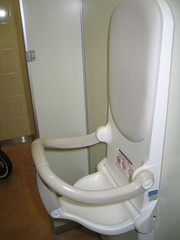
There are sometimes some great things in bathrooms and so on. Anyone who has ever taken an infant to a public toilet can appreciate this product. These were installed in the bathroom stalls at a big electronics store, Bic Camera, at Kyoto Station.

Unfortunately these are not so widespread, but I've seen them here and there. The children's floors of department stores have great facilities for dealing with a baby. The baby care and nursing areas are separate from the bathrooms. They are large and have a big open area with cushioned changing tables, a microwave for heating up baby food (which is generally available for sale nearby if you want it), seats for feeding solid food, and some port-a-cribs. Both men and women can use that area. Beyond that there are double curtains into a private nursing area where men aren't allowed and the chairs are arranged for a degree of privacy from each other.

Our area of Kyoto seems to be low on outdoor playgrounds. The closest park seems to be getting a facelift and has a long way to go before anyone can go inside. But a long walk or short train ride away there is the Kodomo no miraikan, a wonderful free indoor and outdoor playspace. It's open every day except Tuesday from 9-5 or 9-6 and has great stuff for 0-6. Some things remind me of the Children's Museum of Boston and the space for smaller kids there. The pool of wooden balls was really popular with Sam. And Maia had some admirers as usual.

One of Maia's fansIMG_3513
IMG_3521IMG_3515