Saturday, December 27, 2008

Maia's Birthday

Well, I know the idea of this is that you post things right after they happen and so on, but life is hectic. And Maia has gotten interested in typing.

Lovely Miss Maia had her first birthday back in October. She started walking at age one year one day (now she's on the run).

Maia Walking

Sam had been reading a picture book with a great picture of a birthday cake covered with fruit, including melon slices, grapes, and so on. We could not find that one, though maybe we'll find something like that for his birthday. I'm thinking we'll order something for him from the nice bakery near his bus stop where he waits to come home from Youchien. One day he took off his backpack and left it near their shop. We thought it had been left on the bus and so explored that option for awhile, and then called the shop using the number on one of the many point cards they have given us for our previous business. Sure enough when they went outside, now in the dark, to look it was still there. A similarly impressive lost and found experience was when I dropped my Foreigner Registration Card, which one is supposed to carry at all times and takes a month to get, in a taxi. I had not chatted with the driver at all, but he came to my office building where he had dropped me off and found me. He even bowed (as did I). In NYC I'm sure you would hand him a wad of of bills, but this would be considered rude here, implying he would only do things like that for monetary reward.

Anyway, after taking her for an outing to the Kitano Tenmangu flea market we shopped for some cake with fruit on it. I knew there was a Fujiya bakery near the station, and Fujiya is a classic Tokyo store that helped to popularize the ubiquitous strawberry cream cakes that are usually excellent. We picked out a few individual cakes of that sort and let her at it.

DSCN3578.JPG

I only learned later that Fujiya is a bit in the dumps after a scandal last year over using expired cream and allowing too much bacteria in their cakes. Given what Maia did to it, I'm sure there was new bacteria in it anyway, but I felt rather guilty.

DSCN3617.JPG

We got a really classy Christmas cake more recently.

Thursday, November 20, 2008

Sam's Turning Japanese

Evidence:

When asked whether he would like pizza or oden for dinner he said oden. Oden is manufactured fish balls (sort of like fake crab meat, but not exactly), hard boiled eggs, and root vegetables simmered in Japanese stock. In fact, I think it's quite yummy with mustard, but still not what you would expect.

DSCN3898

He also said that a curry donut (fried bread filled with sweet curry stew) was super delicious.

Mmm Curry Donut

He makes lots of sentences in Japanese that reflect his quirky way of thinking. Such as "Mama wa shimauma da. Shimauma daisuki yo!" (Mama, you're a zebra. I love you zebra!)

Wednesday, November 5, 2008

Family and Tranquility

Today was the usual hectic morning getting out of the house. This is what I have to have installed (beyond me just being dressed and vaguely presentable) if I am taking them both:

Sam to wear: white underpants and socks, uniform shorts, short or long-sleeve uniform dress shirt, uniform jacket with name tag attached (since he tried to get lost in the bathroom on a museum field trip this is really important), white shoes put on as we are leaving, hat, plus any other items like an extra coat if needed for warmth or rain.

Sam to carry: backpack with items that have been washed overnight including utensil set, place mat, cup in a little baggy, towel, handkerchief, play uniform shirt(s), shorts, extra underwear and shorts for accidents. On Fridays a lunch. And sometimes other items like forms, smock or hat that needed washing, picture books that need returning (one is borrowed each Thursday and returned with a short report from me on Monday), etc.

Maia to wear: regular clothing and shoes. Backpack for wearing HER.
Maia to bring: refresh in changes of clothing, a cup with a drink (here usually barley tea, but water is OK), lunch and snack, notebook with a report of her sleeping times and morning body temperature, washcloths, and on Monday a small futon which has been aired over the weekend. And if I want to be kind to her caregivers, her beloved pacifier.

Then I walk with all this, plus whatever I need for my own work, on to the bus. We get priority seating with me having a baby attached. They have a nice easy to understand sticker with iconic figures of pregnant lady, lady carrying baby, elderly person, handicapped person. Maia always points at this sticker identifying which one we are (and also which ones the ladies cooing at her are). What I'm looking forward to is when she points to it when a sturdy high school student is sitting there... We take the bus for about 7 minutes and then walk of a similar length to Sam's school. Then Maia and I get back on a bus to go to Kyoto U. which takes about 40 minutes, sometimes longer if it is busy with tourists. I'm engaged in this launching activity from about 7AM to 10AM, at least on the days when I take both kids. Right now my husband's not here, so I've been doing it multiple days in a row.

Anyway, this is rather hard on the body, and the 20 minutes before we leave is rather hectic, involving repeated yelling of phrases like "put on your shoes" and "you CAN do it yourself!" All of this is certainly familiar territory for parents. I breath a huge sigh of relief when it is over.

Today my class involved going to see Tanizaki Jun'ichiro's gravesite at Honen'in Temple off the Philosopher's Trail. Compared to other temples I've been to in Kyoto recently this place was extremely quiet and calming (even with 12 students in tow who were pretty excited about the election results streaming into their cell phones.

IMG_4183.JPG

It was a lovely spot to learn of Obama's victory in the election. Much better than sitting bleary-eyed on a the sofa looking at color-coded maps. ). We're reading Tanizaki's novels these past weeks, so it seemed like a good change of pace to hold class there. It's a peaceful site, and lovely grave. The previous day when I was scoping it out, a woman at a nearby cafe said she had modeled her own husband's grave on Tanizaki's though she was just going to see Tanizaki's in person for the first time. The grave site was of Tanizaki's design and includes a cherry tree he planted and two stones engraved based on his calligraphy. The characters are Jaku and Ie. Jaku means silence or tranquility, and I believe can also indicate entry to nirvana. Ie means family. Tanizaki plays with many pairs in his novels - east/west; kansai/kanto; man/woman, all of which get interestingly confused along the way. I am not sure of Tanizaki's intention with this pairing, but if they are opposite extremes I felt a bit like I was living it over the course of my day. But when I finish this and go sleep with them (minus any Sarah Palin-becomes-president midnight panic attacks!) it might all come together again.

Saturday, October 11, 2008

Undokai

Well the combination of trauma and extreme cuteness kept me silent on this one for one week but here goes.

From primary schools on up schools in Japan almost universally have an undokai - I'll translate that loosely as a fitness extravaganza in the fall. This is where you have your three-legged races and so on, but this is so much more ambitious. Yochien undokai are pretty amazing. These teachers somehow manage to teach groups of 15-20 3-6 year olds to perform dances, make pyramids, race, walk on stilts, and stay with their group for about six hours! For the 3-4 year olds it is less ambitious, but at Sam's school they did a dance, running down the field, a simple obstacle course (go under a tarp, ride a ride on toy, put on a swimming donut, and run to the teacher), parent-child relay, throwing some balls, and then all the various lining up and sitting with their class all day. All the kids attempted all of this and were generally good sports on an 80 degree day.

Well, except Sam. He spent most of the day running off on his own or throwing a tantrum while people attempted to get him involved. He had been quite enjoying the practice leading up to this and showed us various gymnastic moves he was learning - pretty impressive. But some combination of the bright sun (it was unusually hot for October), mobs of people, and just plain stubbornness kept him from enjoying it much that day. I was impressed with how patient the teachers were. I was thinking he was pretty much a lost cause for the day, but a teacher's assistant who has been working with him a lot and his regular teacher when she could get a moment free just kept working to involve him and get him interested. This worked enough to get him into the obstacle course which he had enjoyed in rehearsal.

IMG_3855

And he was willing to do the parent child relay with me. We had fun with that.

IMG_3886

Daddy was roped into tug-of-war. They seemed to think they would win by having the tall foreigner. But one of the other team seemed to have the really young fathers (in red) who were pretty daunting and did in all the 30+ fathers on the other team.


IMG_3904

Anyway, we felt really bad for the teachers who did everything they could to get him to enjoy the experience. Most of the kids really do seem to be having a great time doing all this stuff, and I expect if we were here a year from now he'd be joining in full steam ahead. While we were a bit upset by Sam being so difficult, all the other parents and teachers were very encouraging and supportive of him. The management of these group activities always seems to have built in a strong kids will be kids attitude - kids will do their own thing but they also really like structure and to show off sometimes. I thought the undokai gave most of the kids a chance to learn something new through the complex but coherent dances and tasks in a supportive environment and show it off to themselves and parents.

Wednesday, October 1, 2008

Walking Home

On most days we do the commute to Sam's yochien by bus. We take a bus from our corner, ride it for about 10 minutes, and walk about five minutes on the other end. Of course with a wandering three year old on a busy street, especially in bright sun or pouring rain, the walking part can be interminable, but it is not bad in part because the buses run on schedule and are frequent. Most of his classmates live a bit closer and commute riding on their mothers' bicycles (in seats) - most children wear helmets, no parents wear helmets. About 10% seem to use cars. In my shoes, most of the mothers would use bikes, but those who grew up in this city have been biking for their whole lives on these narrow and busy streets and so are not quite as nervous about it as we have been. Several carry two children on the bike, with a seat installed front and back. I haven't installed even one seat yet though I did buy two children's helmet and brought my own from home.

By foot it is only about 20 minutes for an adult, so sometimes we use our double stroller and walk both ways, usually with at least one child catching a nap. Last Friday I did this and took some photos along the way. They give a sense of some of the things one sees on a random walk in Kyoto.

Here's Sam walking up the path to school...

DSCN3350

OK, his nursery school is not that imposing. This is really the center of the Honganji (Nishi Honganji) complex, the part where most of the tourists go. We made a bit of a pilgrimage on the way home. Sam wanted to go up inside and that would be fine, but there seemed to be rather somber praying going on in the hall, so I lured him back out and took a photo by the huge door. (He's just gotten a big haircut and so is a bit puzzled by being able to find his own ear.)

DSCN3352

Heading out you can see the other side of Horikawa Street, most buildings on which are also connected to Honganji. Here are more modern buildings for the institution, including this large hall. The banners are about liberation from discrimination

DSCN3348

Crossing into a smaller side street, we passed a place that manufactures o-mikoshi, or portable shrines used in Shinto festivals. This is not a museum - you can see boxes in back for shipping them off. I helped carry one of these in the mid-1990s at the Sanja Matsuri in Tokyo. It was only the smaller neighborhood shrine, but I ended up with some pretty impressive bruises and sore muscles.

DSCN3353

I never noticed it before, but Maia seems to have her own building on Nishinotoin Street. And it has nice pink lettering.

DSCN3355

I turned into a smaller side street because I had read that there was a good eel shop. I thought maybe I would buy some prepared eel - this would make a quick dinner together with pickles and rice. But there was a huge crowd in front of the eel place, and they were filming something there. In this photo a car is blocking it, but the shop and the one next to it seemed to be dressed up to look extra quaint. I'll have to go back for eel some other time.

DSCN3357

Nearby there is the Kandaijin Shrine. I never see much tourist traffic here - it is one of the many, many, many rather significant shrines that does not stand out in a city with so many such places. The plaque says that Sugawara no Michizane, a great Heian Period scholar, was first bathed in water from here, and so this spot was devoted to him and is turned to by aspiring students.

DSCN3364

Here's a typical moderate older house plot in the area.

DSCN3361

A restaurant with an interesting name and very old Toyota (I think) in front.

DSCN3365

A great idea for a cafe - get a pet shampoo and have crepes and organic coffee. Or just sit with your dog while you have a coffee. They also advertise "Dog Aromatherapy" "Dog Reflexology" and "French Goods." What dog owner could ask for more?

DSCN3359

DSCN3358

Turning off the busy street, here's a sign for our alley

DSCN3368

and a peaceful look at one leg of our Z-shaped street.

DSCN3371

I wish I could do this every day, but usually I'm dashing back and forth from the other side of Kyoto on some crowded bus...

Thursday, September 11, 2008

We have been able to make some arrangements to help out with Maia's care, and I learned some more about Japanese daycare in the process. Through web searches, and even a PDF document on the Kyoto municipal website, I found a number of small daycare centers that are outside the system run by the Welfare Office. These might be considered unlicensed , or as an article about them calls them "unapproved"(muninka/ninkagai). Some places are in this category because they don't pass certain standards, but most because they want to operate outside the public system and provide services that the "approved" centers do not. Daycare operated by a company would also fall in this category, as they determine their own admissions and do not accept kids via the welfare office application system. Some parents don't qualify for the public daycare system if they are not both working or studying full time, and they may use this as an alternative. There is not a strong tradition of babysitting here either, so you can not usually hire a local high school student cheaply - this provides an alternative to that. The city posts the PDF of ninkagai centers, but did not mention them to me, even when I asked if there might be any alternatives for me while I waited to get into a registered hoikuen.

I visited a couple places on the list of centers that had registered with the city, and chose one with the nicely redundant name of Chiisai peti (Little Petit) near here. They have a lot of flexible plans, and I chose to buy a block of 50 hours for about 45,000 yen. Those can be used over the next three months. That's around 8/hour, so pretty reasonable by Boston standards, and the ratio is three children to one adult. The regular kids there are all close to her age, a lot from 12-15 months, so a nice fit. Though there was also one lonely looking boy about eight years old who must be going there after school.

In exploring this category of care centers, I avoided those marked as "baby hotels" (beebi hoteru). These are places that take babies overnight and have a lot of irregular users. They received a lot of bad press on low-end news and expose programs in the 90s. There were some injuries to children but the focus was on criticizing mothers who used them. I expect most of these have some useful role to play, but I am just a little too put off by the expression.

For October and November she can go to the Center for Women Researchers at Kyoto University which has a system to help women faculty and students who are waiting for spots for their children in the hoikuen system. It's only for two months, but I will use it. The location is halfway between my office and classroom, which is only a seven minutes walk total. I can pick her up three minutes after my LONG afternoon of classes ends on Monday at 6PM. And it's only 50,000/month (about $450) for full-time quality care, provided by one of the companies I researched for temporary care this month. That company runs the daycare center at the Hotel Okura and other such posh locations where there are many temporary and non-Japanese visitors (this is different from "baby hotels"! But since they provide quite late night babysitting at the hotels, they are rather like baby hotels for the rich).

You might ask why this is only for women faculty and students and not all parents. The Center's pamphlet provides some impressive and disheartening statistics about the percentage of faculty who are women at Kyoto University, which is one of the top few universities in the country. Women comprise only 4.2% of full professors, 10.7% of associate professors, and 8.7% of assistant professors. That means the percentage of women full professors at Kyoto University as a whole is half that of tenured women in the natural sciences at Harvard, ie not very high. This center is supposed to help improve that through daycare and elder care support, back-up care when a child is sick and can't be cared for in daycare, as well as research and analyze the obstacles for women scholars. I am not sure what services they provide, but I think the inclusion of elder-care is novel and important as that is a huge burden everywhere, and which women especially are expected by many to bear. This center seems like a pleasant and much-needed facility, so I hope Maia's short stay there will not be too much of a burden since I am only tangentially affiliated with the school. But since Gender Equality and International Relations are both listed among the top six priorities for the university I think I fit.

Monday, September 8, 2008

Kid Conveniences

It has been interesting to see what conveniences for kids there are and what are lacking. The biggest challenge with Maia has been restaurants and seating. Many places have a high chair type seat, and this is great. But they almost never have a belt of any sort, and so really are more for an older child who might stay put, along the lines of a booster seat. Luckily we had some experience with this back in Tokyo when we were staying with a belt maker - Mr. Nagata fashioned a cloth belt with big Velcro patches. This was meant just for one chair they were giving us, but we have ended up traveling with it at all times. Another option in a lot of restaurants is to use a zashiki room where you sit on tatami and she can crawl around.
IMG_3421

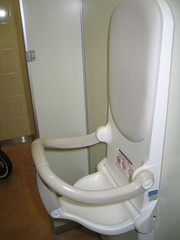
There are sometimes some great things in bathrooms and so on. Anyone who has ever taken an infant to a public toilet can appreciate this product. These were installed in the bathroom stalls at a big electronics store, Bic Camera, at Kyoto Station.

Unfortunately these are not so widespread, but I've seen them here and there. The children's floors of department stores have great facilities for dealing with a baby. The baby care and nursing areas are separate from the bathrooms. They are large and have a big open area with cushioned changing tables, a microwave for heating up baby food (which is generally available for sale nearby if you want it), seats for feeding solid food, and some port-a-cribs. Both men and women can use that area. Beyond that there are double curtains into a private nursing area where men aren't allowed and the chairs are arranged for a degree of privacy from each other.

Our area of Kyoto seems to be low on outdoor playgrounds. The closest park seems to be getting a facelift and has a long way to go before anyone can go inside. But a long walk or short train ride away there is the Kodomo no miraikan, a wonderful free indoor and outdoor playspace. It's open every day except Tuesday from 9-5 or 9-6 and has great stuff for 0-6. Some things remind me of the Children's Museum of Boston and the space for smaller kids there. The pool of wooden balls was really popular with Sam. And Maia had some admirers as usual.

One of Maia's fansIMG_3513
IMG_3521IMG_3515